Tarana Labs / Blog / E-Invoicing
MyInvois e-invoicing: what SMEs must do in 2026
6 min read · 15 Nov 2026 · Tarana Labs
MyInvois e-invoicing is LHDN's system for validating invoices electronically. Instead of a PDF that only you and your customer see, each invoice is submitted to LHDN, checked, given a unique ID and returned with a QR code. The rollout has run in phases since August 2024, and 2026 brought two big changes for SMEs: the last phase started, and the exemption threshold was raised to RM3 million.
This guide explains, in plain language, who must use MyInvois e-invoicing in 2026, who is exempt, what the relaxation period means and what to actually do this month.
Who Must Use MyInvois E-Invoicing In 2026
LHDN phased the rollout by annual turnover or revenue. On 30 August 2026, the official timeline was updated and the exemption threshold rose from RM1 million to RM3 million, following the Prime Minister's announcement.
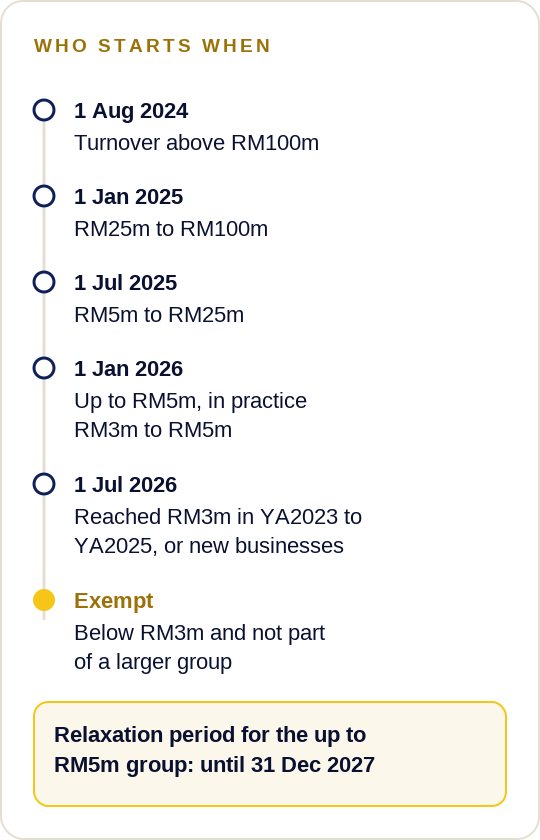
| Annual turnover or revenue | Must start e-invoicing |
|---|---|
| Above RM100 million | 1 August 2024 |
| Above RM25 million, up to RM100 million | 1 January 2025 |
| Above RM5 million, up to RM25 million | 1 July 2025 |
| Up to RM5 million (in practice RM3 million to RM5 million) | 1 January 2026 |
| Reached RM3 million in YA2023, YA2024 or YA2025, or started operating in those years with RM3 million or more | 1 July 2026 |
| Below RM3 million and meeting the exemption criteria | Exempt |
The RM3 Million Exemption
If your annual turnover or revenue is below RM3 million, you are exempt from e-invoicing, as long as you meet the criteria in section 1.6.10 of LHDN's e-Invoice Guideline. The main catch is group structure: the exemption may not apply if a corporate shareholder, holding company, related company or joint venture brings the group over the threshold. If your company is a standalone business, you are most likely exempt.
LHDN's FAQ, updated 4 September 2026, also answers the question many small businesses asked: if you already started issuing e-invoices and you now fall below RM3 million, you may stop. No application to LHDN is needed. You may also carry on voluntarily, and LHDN encourages that.
When You Grow Past RM3 Million
If your turnover reaches RM3 million in YA2026 or later, you must start e-invoicing on 1 January of the second year after that year of assessment. Growth gives you time to prepare, but the date comes round quickly, so plan ahead.
The Relaxation Period Runs To 31 December 2027
Every phase got an interim relaxation period, and for the up to RM5 million group, it covers both the 1 January 2026 and 1 July 2026 start dates and runs until 31 December 2027. During this period, LHDN allows some simplifications for businesses whose systems are not yet ready, such as issuing consolidated e-invoices where an individual e-invoice would normally be required.
Two things the relaxation period does not mean:
- It does not mean you can wait until 2027 to start. Consolidated e-invoices must still be issued monthly, within seven calendar days after the month ends.
- It does not cover everything. From 1 January 2026, a single transaction above RM10,000 should not go into a consolidated e-invoice; it needs its own individual e-invoice, according to LHDN's e-Invoice Specific Guideline.
How One E-Invoice Works
The life of an e-invoice is the same whether you use LHDN's free portal or your own software:
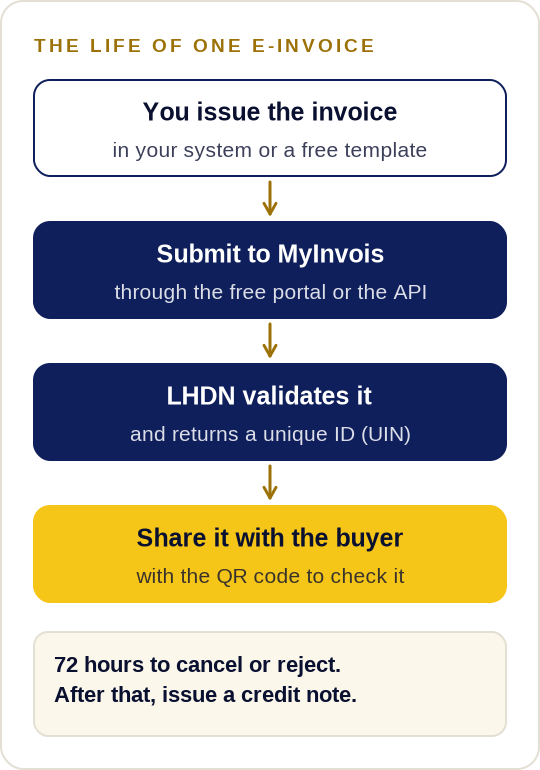
- Issue. You create the invoice with the required fields, including your buyer's tax identification number (TIN) where you have it.
- Submit. You send it to the MyInvois System, either through the MyInvois Portal or through the API from your accounting or sales system.
- Validate. LHDN checks it and assigns a Unique Identifier Number (UIN).
- Share. You give the validated e-invoice, with its QR code, to the buyer. Anyone can scan the code to check it.
If you spot a mistake, you can cancel the e-invoice within 72 hours of validation, and the buyer can request a rejection within the same window. After that, corrections go through a credit note, debit note or refund note that refers to the original UIN.
Selling To The Public: Consolidated E-Invoices
Shops and restaurants that sell to individuals who do not ask for an e-invoice can issue a single consolidated e-invoice for those sales each month, within seven days after the month ends. If a customer does ask for one, you issue them an individual e-invoice. Your point of sale system should make that easy, with a QR code on the receipt for customers to request one.
What SMEs Should Do Now
If You Are Below RM3 Million
- Confirm your turnover for the relevant years and check that no related or holding company pushes you over the threshold.
- Keep issuing normal invoices or receipts. You can make clean, professional invoices with SST using our free Invoice Generator. These are standard invoices, not validated e-invoices.
- Be ready to receive e-invoices from your suppliers and to give your TIN when asked. Larger suppliers will request it.
- Watch your growth. Set a reminder to check turnover each year.
If You Are RM3 Million Or Above
- Register and log in to MyInvois with your business's TIN, and assign access to the staff who will handle invoices.
- Choose how you will submit. The MyInvois Portal is free and supports both single invoices and batch uploads by spreadsheet. Better, use accounting or POS software that connects to the API, so invoices are submitted automatically.
- Clean your customer data. Collect TINs and registration numbers for business customers now. Missing data is the most common cause of delays.
- Set up consolidated e-invoicing for walk-in sales and a way for customers to request their own.
- Separate big transactions. Make sure any single sale above RM10,000 gets an individual e-invoice.
- Train one person to own e-invoicing and check the monthly consolidated submission.
Connecting Your Own System
If your business already runs on a custom system, connecting it to the MyInvois API removes double entry: an invoice created in your system is submitted, validated and stamped with its QR code automatically. LHDN publishes the technical documentation as the e-Invoice SDK. This is one of the features in an admin management portal, and the App Cost Calculator shows what adding it typically costs.
If you also run payroll, our guide to PCB in Malaysia for 2026 walks through the monthly tax deduction with a worked example.
Questions
Is my business exempt from e-invoicing in 2026?
If your annual turnover or revenue is below RM3 million and you meet the criteria in section 1.6.10 of the e-Invoice Guideline, yes. The main exception is when a shareholder, holding company, related company or joint venture brings the group to RM3 million or more.
I started e-invoicing in January 2026 but my turnover is below RM3 million. Can I stop?
Yes. LHDN's FAQ says businesses below RM3 million that meet the exemption criteria may stop immediately without applying, or continue voluntarily.
Is the MyInvois Portal free?
Yes. LHDN provides the MyInvois Portal and the MyInvois mobile app free of charge. Software that connects through the API is sold by private vendors or built for you.
Is a PDF invoice an e-invoice?
No. An e-invoice is only valid once it has been submitted to and validated by LHDN's MyInvois System and given a Unique Identifier Number. A PDF you email is a normal invoice.
What happens if I make a mistake on an e-invoice?
Within 72 hours of validation you can cancel it and issue a correct one. After 72 hours, issue a credit note, debit note or refund note that refers to the original e-invoice.
Sources
- LHDN: e-Invoice implementation timeline
- LHDN: e-Invoice FAQs, updated 4 September 2026
- LHDN: e-Invoice Specific Guideline
- LHDN: MyInvois e-Invoice SDK
Related Articles
- How to get your business recommended by ChatGPT and Claude (AI And Search, 28 Nov 2026): How AI assistants like ChatGPT, Claude and Perplexity pick which businesses to recommend, and the five fixes that help a Malaysian business get named.
- PCB in Malaysia 2026, explained with one payslip (Tax And Payroll, 22 Nov 2026): What PCB is, how LHDN's 2026 formula works and why it lands where it does, walked through one example RM5,000 payslip line by line, with EPF, SOCSO and EIS.
- How much does an app or website cost in Malaysia in 2026? (Apps And Websites, 9 Nov 2026): Honest 2026 ringgit ranges for a website, online shop, mobile app or business system in Malaysia, what moves the price, and the monthly running costs to budget.