Tarana Labs / Blog / Tax And Payroll
PCB in Malaysia 2026, explained with one payslip
6 min read · 22 Nov 2026 · Tarana Labs
PCB, or Potongan Cukai Bulanan, is the income tax your employer takes from your salary every month and pays to LHDN for you. In English it is called the Monthly Tax Deduction (MTD). Most people only notice PCB in Malaysia when the number on the payslip changes, so this guide explains PCB in Malaysia for 2026 the practical way: with one payslip, worked through line by line.
The figures below are an example, for a single employee with no other reliefs. Your own PCB depends on your pay, your family situation and the reliefs you claim. Use the PCB calculator to run your own numbers.
What PCB In Malaysia Actually Is
PCB is not an extra tax. It is your yearly income tax, collected in twelve monthly slices so you do not face one large bill in April. At the end of the year you file your tax return (Form BE for most employees), LHDN works out the exact tax you owe, and the PCB already paid is counted against it. If too much was deducted you get a refund; if too little, you pay the balance.
For 2026 there is one useful thing to know: LHDN's computerised calculation specification for 2026 states that there is no amendment to the MTD formula. Budget 2026 adjusted and expanded some reliefs, which changes the inputs for some employees, but the method is the same as last year.
The Example Payslip
Meet our example employee. She is single, a Malaysian resident under 60, earns a basic salary of RM5,000 a month with no allowances or bonus, and has not submitted any extra reliefs to her employer. Here is her November payslip.
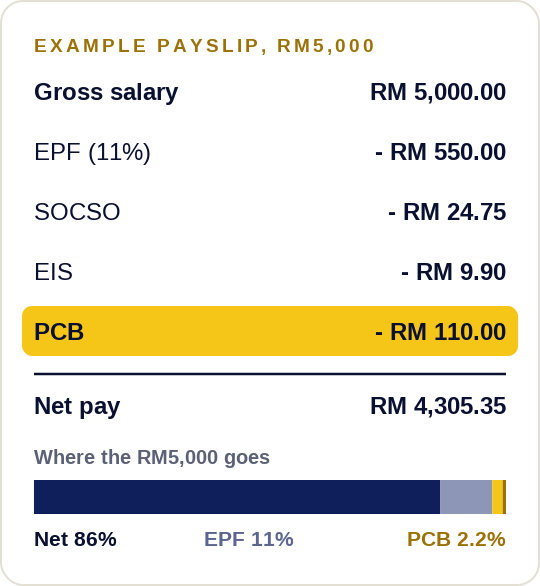
| Line | Amount |
|---|---|
| Gross salary | RM5,000.00 |
| EPF, employee 11% | RM550.00 |
| SOCSO, employee share | RM24.75 |
| EIS, employee share | RM9.90 |
| PCB | RM110.00 |
| Net pay | RM4,305.35 |
Let us take each deduction in turn.
EPF: RM550
The employee share of EPF (KWSP) is 11% of monthly wages for Malaysians under 60. The employer adds its own share on top, which does not come out of her pay: 13% when wages are RM5,000 or below and 12% above that. EPF matters for PCB because part of it is tax relief, as you will see below.
SOCSO And EIS: RM24.75 And RM9.90
SOCSO (PERKESO) contributions follow a table of wage bands. Since 1 October 2024 the wage ceiling for contributions is RM6,000 a month. For a wage between RM4,900.01 and RM5,000, the employee's share under the first category is RM24.75, and the Employment Insurance System (EIS) share is RM9.90. Always check the current PERKESO table for other wage levels.
Since 1 June 2026, employees covered by PERKESO's LINDUNG 24 Jam scheme (protection for non-work accidents) pay a further share from the same wage table: RM37.15 at this wage, which would bring net pay to RM4,268.20. The example above leaves it out. The PCB Calculator lets you switch it on or off.
PCB: RM110
This is the interesting one. LHDN's formula does not simply apply a percentage to each month's pay. It estimates your tax for the whole year, then spreads it over the months that are left.
How The RM110 Is Worked Out
The computerised formula in LHDN's specification looks intimidating:
PCB for the month = [ (P − M) × R + B − (Z + X) ] ÷ (n + 1)
In plain language, P is your estimated chargeable income for the year, M, R and B come from the tax table for the band P falls in, Z is zakat already paid, X is PCB already paid this year, and n + 1 is the number of months left including this one. For a steady salary from January, it simplifies neatly to "the year's tax divided by twelve".
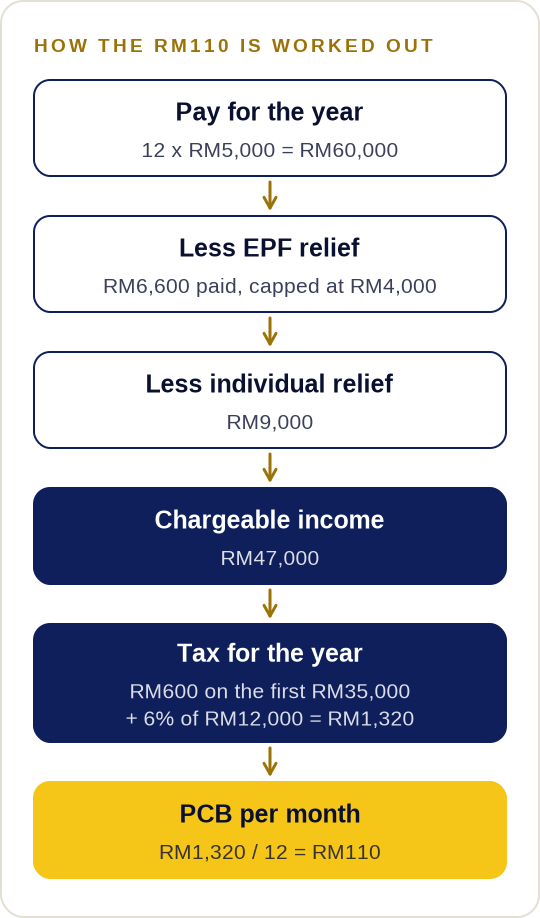
Step 1: Estimate The Year's Income
RM5,000 × 12 months = RM60,000.
Step 2: Take Off EPF Relief
She pays RM6,600 of EPF in a year, but the tax relief for EPF contributions is capped at RM4,000. LHDN's formula spreads that cap across the year, so the relief stops growing once RM4,000 is reached.
Step 3: Take Off Personal Relief
Every resident individual gets RM9,000 of personal relief.
RM60,000 − RM4,000 − RM9,000 = RM47,000 chargeable income.
Step 4: Apply The Tax Table
RM47,000 falls in the RM35,001 to RM50,000 band. LHDN's table says the tax on the first RM35,000 is RM600, and each ringgit above that is taxed at 6%. The RM400 rebate only applies when chargeable income is RM35,000 or less, so she does not get it.
RM600 + 6% × (RM47,000 − RM35,000) = RM600 + RM720 = RM1,320 tax for the year.
Step 5: Spread It Over The Year
RM1,320 ÷ 12 = RM110 a month.
That is the number on her payslip. Over a full year her PCB adds up to exactly the tax she owes, so if nothing changes, her tax return should show nothing to pay and nothing to refund.
Why Your PCB Might Differ From This Example
- Reliefs you claim. You can give your employer Form TP1 to count reliefs like life insurance, medical expenses, lifestyle purchases or education fees in your monthly PCB, instead of waiting for your tax return. Each relief lowers P and so lowers PCB. SOCSO and EIS contributions, for example, qualify for up to RM350 of relief.
- Your family. A married employee whose spouse does not work, or who has children, falls under a different category in the formula and gets spouse and child reliefs.
- Bonuses and allowances. A bonus month uses an additional remuneration calculation, which is why PCB jumps when a bonus is paid.
- Changing jobs. Give your new employer Form TP3 with your earnings and PCB so far this year, otherwise each employer calculates as if you had no other income and the total can be wrong.
- Rounding. PCB is rounded up to the nearest 5 sen, and if the calculated amount is less than RM10, the employer does not deduct it.
- Zakat. Zakat paid through salary deduction reduces PCB ringgit for ringgit.
What Employers Need To Do
If you run payroll for a small business, the duties are simple but strict:
- Deduct PCB every month using the LHDN formula or tables, or payroll software that follows the official specification.
- Pay it to LHDN through e-PCB Plus by the 15th of the following month.
- Keep each employee's TP1 and TP3 forms on file.
- Issue every employee an EA form after the year ends so they can file their return.
Getting PCB wrong usually means penalties for the employer, not the employee, so it is worth checking. Our free PCB calculator follows the 2026 specification and shows each step. If you are also sorting out invoicing, read what SMEs must do for MyInvois e-invoicing in 2026.
Questions
Is PCB my final tax?
Not always. PCB is an advance payment towards your yearly tax. If your only income is salary and your reliefs are all declared through TP1, PCB is often close to final. Otherwise the difference is settled when you file your return.
Why is my PCB zero?
Because of the RM400 rebate, tax comes to nothing when chargeable income is up to about RM28,300 a year, and a calculated PCB below RM10 is not deducted at all. For a single employee with no other reliefs, using the same method as our example, that works out to a salary of roughly RM3,400 a month or less.
Can I ask my employer to deduct more PCB?
Yes. You can ask for an additional deduction each month, for example if you have rental income and want to avoid a bill at year end. The formula treats it separately from the standard PCB.
Do foreign employees pay PCB?
Yes. Foreign employees who are tax resident, generally those in Malaysia for 182 days or more in the year, are taxed on the same resident scale. Non-residents are taxed at a flat 30% rate. Since late 2025, foreign workers also contribute 2% to EPF, with employers adding 2%.
Did the PCB formula change for 2026?
No. LHDN's 2026 specification keeps the same formula. Some reliefs were adjusted in Budget 2026, so the TP1 form and the amounts you can claim have changed, but the calculation method has not.
Sources
- LHDN: Specification for Monthly Tax Deduction (MTD) Calculations Using Computerised Calculation for 2026
- KWSP: Employer mandatory contribution
- KWSP: Contribution for non-Malaysian citizen employees
- PERKESO: Contribution rate
Related Articles
- How to get your business recommended by ChatGPT and Claude (AI And Search, 28 Nov 2026): How AI assistants like ChatGPT, Claude and Perplexity pick which businesses to recommend, and the five fixes that help a Malaysian business get named.
- MyInvois e-invoicing: what SMEs must do in 2026 (E-Invoicing, 15 Nov 2026): Who must issue MyInvois e-invoices in 2026, the new RM3 million exemption, the relaxation period to 2027 and the practical steps for a Malaysian SME.
- How much does an app or website cost in Malaysia in 2026? (Apps And Websites, 9 Nov 2026): Honest 2026 ringgit ranges for a website, online shop, mobile app or business system in Malaysia, what moves the price, and the monthly running costs to budget.